
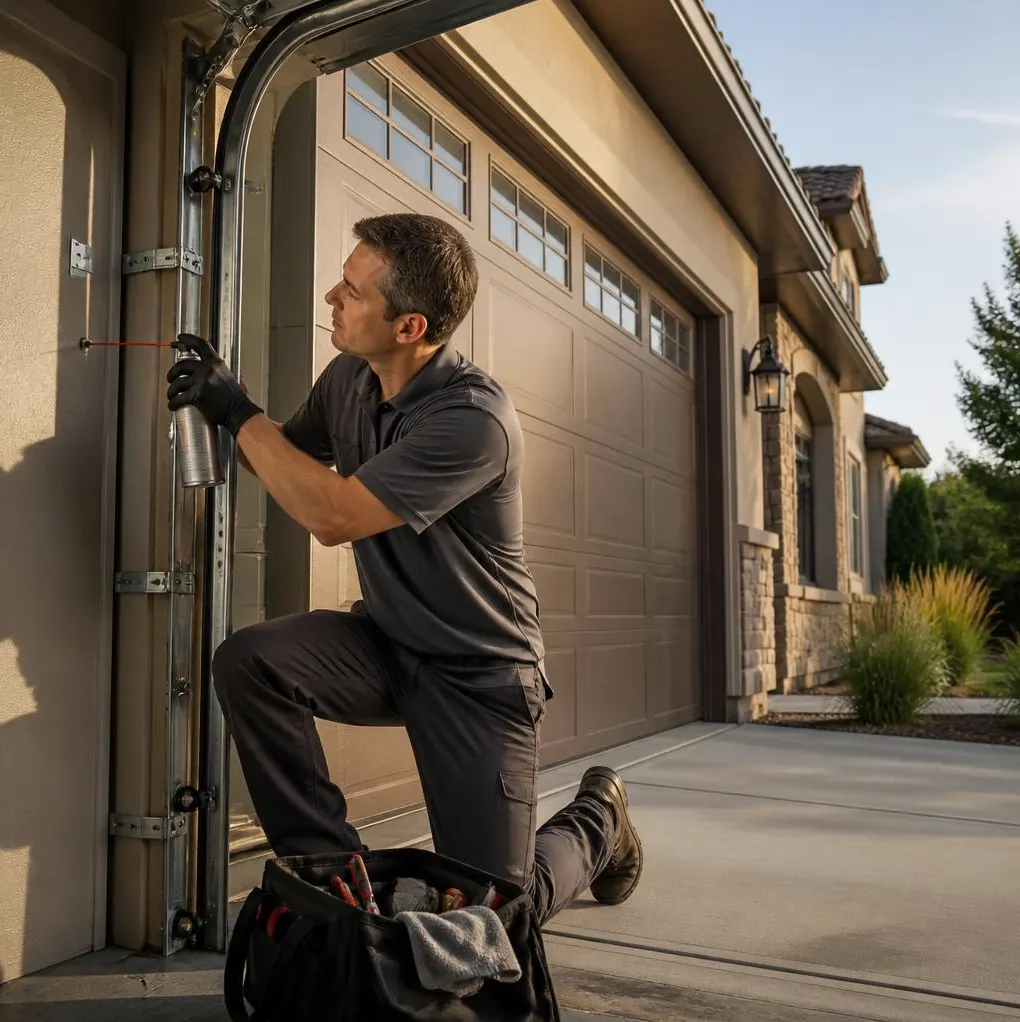
If your garage door starts closing and then reverses back up, or won't close at all, the most common cause is a pair of misaligned or dirty safety sensors near the bottom of the tracks. That's the first thing worth checking yourself. But sensors aren't the only culprit, and a technician works through a specific list of suspects, in order, before landing on a diagnosis.
What This Usually Looks Like
A few patterns show up again and again:
- The door starts down, stops a few inches from the floor, and reverses all the way back up.
- The door won't move at all when you press close, even though it opens fine.
- The opener light blinks a set number of times, which is a built-in error code most brands use to point at the sensors or a limit problem.
- The door closes fine some days and not others, especially after a cold snap or a heavy rain.
That last pattern matters here. With the swing into colder fall nights, grease in the opener's drive and on the rollers starts to thicken, hardware contracts slightly, and anything that was borderline during the humid summer months often becomes a daily problem once temperatures drop.
Causes, in the Order a Technician Checks Them
1. Safety Sensors (Photo-Eyes)
These two small units sit a few inches off the floor on either side of the door and send an invisible beam across the opening. If anything blocks that beam, including dust, spiderwebs, a stray leaf, or sunlight hitting the lens at the wrong angle, the opener assumes something is in the way and reverses the door. The fix is usually simple: wipe both lenses clean, check that neither sensor has been bumped out of alignment by a car, a broom, or seasonal yard equipment being moved in and out, and confirm both have a solid, steady light (most units show green when aligned, and one blinks when they're not talking to each other).
2. Sensor Wiring and Connections
If the lenses are clean and aligned but the light still won't go solid, the wire running to one sensor may be damaged, pinched, or corroded at the connection. This happens more often in garages that see humidity swings through the summer followed by cooler, drier air in fall, since the repeated expansion and contraction can loosen a crimped connector over time. A technician checks continuity and replaces the wire or connector rather than the whole sensor when possible.
3. Track Obstructions or Misalignment
Next comes a physical inspection of both tracks for dents, debris, or a section that's pulled slightly away from the frame. Garages attached to older homes in this area sometimes have tracks that have shifted slightly with the house settling, and that small gap is enough to make the door bind and trigger a reversal. Fall leaf litter and acorns can also work their way into the bottom track and cause the same symptom.
4. Opener Limit and Force Settings
Every opener has a setting that tells it how far to travel and how much resistance to tolerate before assuming it's hit an obstruction. If these are set too sensitive, the door reverses even when nothing is in the way, particularly once the door gets harder to move as grease thickens in colder weather. Resetting the limits and force settings according to the opener's manual often resolves this, though it's worth doing carefully since settings that are too loose create a real safety hazard.
5. Worn Rollers and Hinges
Rollers that are cracked, flat-sided, or caked with old grease and grit make the door travel unevenly, which the opener can read as an obstruction. Houses here that go through humid summers followed by salt and ice through winter tend to see roller wear and light surface rust show up a bit faster than in milder climates. Replacing worn rollers and re-lubricating hinges and track is a straightforward maintenance job that often prevents this issue from coming back.
6. Spring Tension and Balance
If the door reverses specifically near the top of its travel, or feels unusually heavy when lifted by hand with the opener disconnected, a weakened torsion or extension spring is a likely cause. A door that's out of balance forces the opener motor to work harder than it's rated for, which trips the same force-sensing safety feature as a true obstruction. Spring tension isn't something to adjust without the right tools and training; a technician measures the door's balance and replaces springs as a matched pair when needed, since mismatched spring tension creates its own problems.
7. Opener Logic Board
When every mechanical and sensor check comes back clean and the behavior is still inconsistent, the opener's circuit board itself may be failing. This is more common in units ten or more years old, and it shows up as random reversals, delayed responses, or a remote that works intermittently. At this point, repair usually gives way to a conversation about opener replacement.
When to Call Munroe Falls Garage Door
If you've wiped the sensors, checked for obvious obstructions, and the door is still reversing or won't close, it's time to call. Our technicians carry out this same sequence with the tools to test spring balance safely and read opener diagnostics, and we handle everything from a quick Garage Door Repair visit to full Spring Replacement when that's the root cause. We serve homeowners throughout Munroe Falls, Stow, Tallmadge, Cuyahoga Falls, Hudson, Kent, Silver Lake, and Akron, and we show up ready to fix it the same visit whenever possible.
Don't wait until the door is stuck open or shut on a cold Munroe Falls morning. Call Munroe Falls Garage Door today to get your door diagnosed and working reliably before winter sets in.